
Laboratory Glassware Manufacturer in India | Complete Global Supply Guide

Laboratory Glassware Manufacturer in India: Complete Global Supply Guide

India has become one of the fastest-growing global hubs for scientific manufacturing, including the production of high-quality laboratory glassware for research institutions, pharmaceutical companies, industrial laboratories, distributors, and educational facilities worldwide.

Today, many international buyers prefer working with a reliable laboratory glassware manufacturer in India because of the combination of manufacturing expertise, export capability, product variety, and competitive supply solutions.

At Biohall Lifesciences, we manufacture premium-quality borosilicate laboratory glassware designed for laboratories and distributors seeking precision, durability, and dependable international supply standards.


Why India Is a Global Hub for Laboratory Glassware Manufacturing

India’s scientific manufacturing sector has grown significantly over the past decade. Modern laboratories across multiple industries require dependable scientific glassware capable of meeting strict quality and calibration standards.

A professional laboratory glassware manufacturer in India typically offers:

  • Borosilicate laboratory glassware
  • Class A and Class B glassware
  • Precision calibration
  • Bulk manufacturing capability
  • Export-ready packaging
  • OEM/private label solutions

This combination makes India a preferred sourcing destination for laboratory distributors and procurement companies globally.


What Makes a Reliable Laboratory Glassware Manufacturer?

Selecting the right supplier is critical for maintaining laboratory accuracy, durability, and operational reliability.

Key Factors to Consider:

1. Borosilicate 3.3 Glass Quality

Premium manufacturers use borosilicate 3.3 glass, known for:

  • High thermal resistance
  • Chemical durability
  • Low thermal expansion
  • Long laboratory service life

This material is widely preferred in scientific and industrial laboratory environments.


2. Calibration and Accuracy Standards

Reliable scientific glassware manufacturers follow strict calibration procedures to ensure accurate laboratory measurements.

Precision calibration is especially important for:

  • Volumetric flasks
  • Burettes
  • Pipettes
  • Measuring cylinders

High-quality calibration improves laboratory consistency and scientific confidence.


3. Product Range and Manufacturing Capability

A professional laboratory glassware company in India should offer a broad product portfolio suitable for multiple laboratory applications.

Common Laboratory Glassware Products:

A diverse product range simplifies sourcing for distributors and laboratories.


4. Export-Ready Packaging and Global Supply

International buyers require suppliers capable of secure packaging and dependable export logistics.

Leading laboratory glassware exporters in India provide:

  • Protective export packaging
  • Bulk shipment capability
  • International documentation support
  • Consistent production quality
  • Reliable global dispatch systems

This is essential for reducing transit damage and maintaining supply continuity.


Industries That Use Laboratory Glassware

Laboratory glassware is widely used across multiple scientific and industrial sectors.

Pharmaceutical Industry

Used for formulation, testing, and analytical procedures.

Educational Institutions

Required for chemistry demonstrations and laboratory practicals.

Research Laboratories

Used for scientific experimentation and precision measurement.

Industrial Testing Facilities

Supports quality control and industrial analysis applications.

Chemical Laboratories

Used for chemical handling, reactions, and testing operations.


Why Borosilicate Laboratory Glassware Is Preferred

Modern laboratories prefer borosilicate laboratory glassware because it provides superior durability compared to ordinary glass.

Advantages Include:

  • Excellent thermal stability
  • Chemical resistance
  • High transparency
  • Reduced breakage risk
  • Long-term reliability

These properties make borosilicate glass suitable for demanding laboratory conditions worldwide.


How Distributors Choose Laboratory Glassware Suppliers

Laboratory distributors and procurement teams usually evaluate suppliers based on:

  • Manufacturing consistency
  • Calibration quality
  • Product availability
  • Export capability
  • Packaging standards
  • Product durability
  • Long-term supply reliability

A dependable laboratory glassware supplier for distributors helps businesses maintain customer confidence and operational efficiency.


Growing Global Demand for Indian Laboratory Glassware

As scientific infrastructure continues to expand worldwide, demand for reliable laboratory glassware suppliers in India continues to increase.

International buyers increasingly seek:

  • Cost-effective manufacturing
  • Premium quality standards
  • Stable supply chains
  • Bulk procurement capability
  • OEM/private label support

This has positioned India as an important contributor to the global scientific supply industry.


Conclusion

Choosing the right laboratory glassware manufacturer in India is essential for laboratories, distributors, and procurement companies seeking accuracy, durability, and dependable scientific performance.

With growing global demand for high-quality scientific glassware, manufacturers specializing in borosilicate laboratory glassware, export-ready supply, and precision calibration continue to play a critical role in supporting laboratories worldwide.

Biohall Lifesciences manufactures export-quality laboratory glassware designed for scientific reliability, global supply standards, and long-term laboratory performance.

FREQUENTLY ASKED QUESTIONS

Laboratory Glassware Manufacturer FAQ

Learn more about laboratory glassware manufacturing in India, borosilicate laboratory glassware, export standards, and scientific supply solutions.
Why are laboratory glassware manufacturers in India globally preferred?
Laboratory glassware manufacturers in India are globally preferred because of their manufacturing expertise, competitive supply capability, borosilicate glass quality, and strong export infrastructure for international scientific markets.
What type of glass is used in laboratory glassware?
Most premium laboratory glassware is manufactured using borosilicate 3.3 glass because of its excellent thermal resistance, chemical durability, and long-term scientific performance.
What products are manufactured by laboratory glassware companies?
Laboratory glassware companies manufacture scientific products including beakers, volumetric flasks, burettes, condensers, cylinders, funnels, reagent bottles, adapters, and filtration glassware.
Why is calibration important in laboratory glassware?
Calibration ensures laboratory measurement accuracy, consistency, and dependable scientific results, especially for volumetric laboratory glassware used in analytical procedures.
Which industries use laboratory glassware?
Laboratory glassware is widely used in pharmaceutical laboratories, educational institutions, chemical industries, industrial testing facilities, research centers, and scientific laboratories worldwide.
What should distributors look for in laboratory glassware suppliers?
Distributors should evaluate product quality, borosilicate glass standards, calibration accuracy, export packaging, manufacturing consistency, and long-term global supply capability when selecting laboratory glassware suppliers.

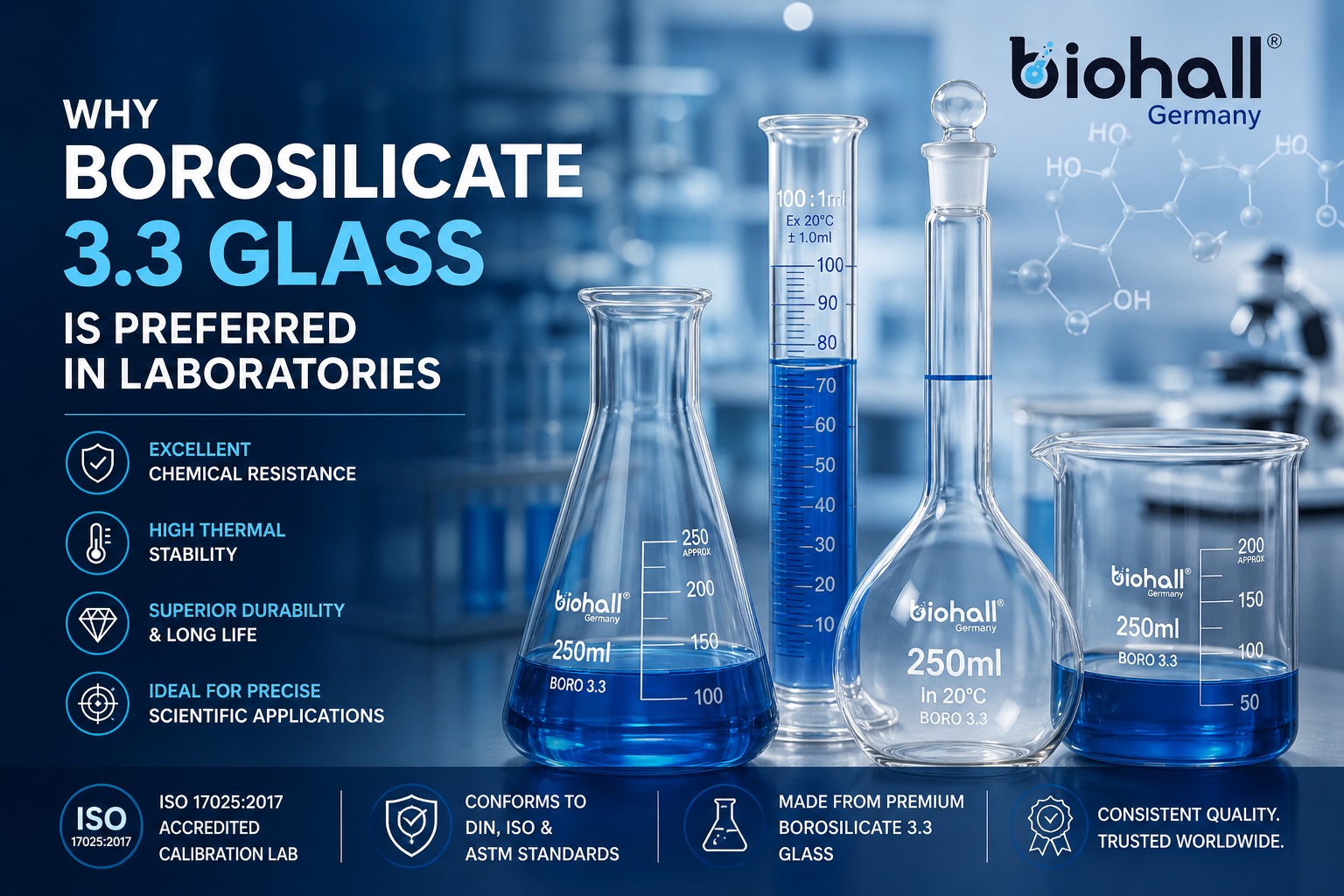
Why Borosilicate 3.3 Glass Is Preferred in Laboratories

Why Borosilicate 3.3 Glass Is Preferred in Laboratories

Modern laboratories require glassware that can withstand high temperatures, aggressive chemicals, repeated usage, and demanding scientific environments. This is why borosilicate 3.3 glass has become the preferred material for laboratory glassware used in research institutions, pharmaceutical facilities, educational laboratories, and industrial testing environments worldwide.

Known for its excellent thermal resistance, chemical durability, and long service life, borosilicate laboratory glassware plays a critical role in ensuring safe and accurate scientific operations.

At Biohall Lifesciences, we manufacture premium-quality borosilicate laboratory glassware designed for laboratories, distributors, and global scientific supply requirements.


What Is Borosilicate 3.3 Glass?

Borosilicate 3.3 glass is a specialized type of laboratory glass containing silica and boron trioxide, engineered to provide superior resistance against thermal shock and chemical corrosion.

Compared to ordinary glass, laboratory borosilicate glass expands very little when exposed to heat, making it highly reliable for scientific applications involving temperature changes and direct heating.


Why Laboratories Prefer Borosilicate 3.3 Glass

1. Excellent Thermal Resistance

One of the biggest advantages of borosilicate 3.3 glass is its ability to handle high temperatures without cracking or deforming.

Laboratory procedures often involve:

  • Direct flame heating
  • Hot plate applications
  • Rapid temperature changes
  • Chemical reactions under heat

Borosilicate laboratory glassware maintains structural stability under these demanding conditions, making it ideal for scientific work.

Common Applications:

  • Heating solutions
  • Distillation processes
  • Chemical reactions
  • Sterilization procedures

2. Superior Chemical Resistance

Scientific laboratories regularly work with acids, alkalis, solvents, and reactive chemicals. Ordinary glass can degrade under such exposure, while chemical resistant glassware made from borosilicate offers dependable performance.

Borosilicate glass resists:

  • Acid corrosion
  • Chemical staining
  • Surface degradation
  • Contamination risks

This helps maintain experimental accuracy and laboratory safety.


3. High Durability for Repeated Laboratory Use

Laboratory environments demand glassware that can withstand repeated handling, cleaning, heating, and testing procedures.

Borosilicate laboratory glassware provides:

  • Long service life
  • Reduced breakage risk
  • Reliable laboratory performance
  • Improved operational efficiency

Its durability makes it suitable for educational, industrial, pharmaceutical, and research laboratories.


4. Low Thermal Expansion

One of the key properties of borosilicate 3.3 glass is its low coefficient of thermal expansion.

This means the glass:

  • Expands very little under heat
  • Reduces thermal stress
  • Minimizes cracking risk
  • Handles sudden temperature changes effectively

This characteristic is especially important in scientific experiments requiring consistent and controlled heating.


5. High Transparency and Clarity

Scientific procedures require clear observation of liquids, reactions, and measurements. Borosilicate laboratory glassware offers excellent optical clarity for accurate monitoring and laboratory visibility.

This improves:

  • Observation accuracy
  • Measurement visibility
  • Quality control procedures
  • Laboratory precision

Common Laboratory Glassware Made from Borosilicate 3.3 Glass

Many essential laboratory products are manufactured using borosilicate glass.

Examples Include:

  • Laboratory beakers
  • Volumetric flasks
  • Conical flasks
  • Burettes
  • Cylinders
  • Condensers
  • Reagent bottles
  • Pipettes
  • Distillation apparatus

These products are widely used across scientific and industrial laboratories worldwide.

ISO Standards Organization


Applications of Borosilicate Glass in Laboratories

Research Laboratories

Used for analytical testing, heating applications, and scientific experimentation.

Pharmaceutical Laboratories

Supports formulation, chemical analysis, and controlled laboratory procedures.

Educational Institutions

Ideal for chemistry demonstrations, experiments, and practical training.

Industrial Laboratories

Used in quality control, industrial analysis, and material testing applications.


Why High-Quality Laboratory Glassware Matters

Using premium-quality laboratory borosilicate glass improves:

  • Laboratory safety
  • Measurement reliability
  • Chemical compatibility
  • Scientific accuracy
  • Operational durability

Trusted laboratory glassware manufacturers follow strict quality control and precision manufacturing standards to ensure dependable scientific performance.


Conclusion

The combination of thermal stability, chemical resistance, durability, and clarity makes borosilicate 3.3 glass the preferred choice for modern laboratories worldwide. Whether used in research, pharmaceutical, industrial, or educational environments, borosilicate laboratory glassware provides dependable performance under demanding scientific conditions.

Biohall Lifesciences manufactures export-quality borosilicate laboratory glassware designed for laboratories and distributors seeking precision, durability, and international quality standards.

FREQUENTLY ASKED QUESTIONS

Borosilicate 3.3 Glass FAQ

Learn why borosilicate 3.3 glass is widely preferred in scientific laboratories for thermal resistance, durability, and chemical stability.

What is borosilicate 3.3 glass?
Borosilicate 3.3 glass is a specialized laboratory glass containing silica and boron trioxide, designed for excellent thermal resistance, chemical durability, and scientific reliability.
Why is borosilicate glass preferred in laboratories?
Borosilicate glass is preferred because it withstands high temperatures, sudden thermal changes, and chemical exposure while maintaining clarity and structural stability.
Is borosilicate glass heat resistant?
Yes, borosilicate 3.3 glass is highly heat resistant and can safely handle laboratory heating procedures, hot plate applications, and temperature fluctuations.
What laboratory products are made from borosilicate glass?
Many scientific products are manufactured using borosilicate glass, including laboratory beakers, volumetric flasks, cylinders, burettes, condensers, reagent bottles, and distillation apparatus.
Why is chemical resistance important in laboratory glassware?
Chemical resistance helps laboratory glassware withstand acids, alkalis, solvents, and reactive substances without degradation, ensuring safe and accurate scientific work.
Which industries use borosilicate laboratory glassware?
Borosilicate laboratory glassware is widely used in research laboratories, pharmaceutical facilities, educational institutions, chemical industries, and industrial testing environments.

Types of Laboratory Beakers and Their Uses

Types of Laboratory Beakers and Their Uses

Laboratory beakers are among the most widely used pieces of scientific glassware in research laboratories, educational institutions, industrial facilities, and pharmaceutical environments. From mixing and heating chemicals to preparing solutions and conducting experiments, laboratory beakers play an essential role in daily laboratory operations.

Understanding the different types of laboratory beakers, their sizes, materials, and applications helps laboratories select the right glassware for accuracy, safety, and durability.

At Biohall Lifesciences, we manufacture premium-quality borosilicate laboratory beakers designed for laboratories, distributors, and global scientific supply requirements.


What is a Laboratory Beaker?

A laboratory beaker is a cylindrical container with a flat bottom used for holding, mixing, heating, and pouring liquids during laboratory procedures. Most chemistry laboratory beakers include a small pouring spout and graduation markings for approximate measurements.

Beakers are commonly manufactured using borosilicate glass, known for its thermal resistance, chemical durability, and clarity.


Common Types of Laboratory Beakers

1. Griffin Beaker (Low Form Beaker)

The Griffin beaker is the most common type of laboratory beaker used in scientific laboratories worldwide. It features a wide diameter with a lower height, making it suitable for mixing, heating, and general-purpose laboratory applications.

Common Uses:

  • Mixing chemicals
  • Heating solutions
  • Sample preparation
  • Educational laboratory experiments

Advantages:

  • Easy handling
  • Stable base
  • Convenient pouring spout

2. Berzelius Beaker (Tall Form Beaker)

Berzelius beakers are taller and narrower compared to Griffin beakers. Their design helps reduce splashing and improves liquid handling during experiments.

Common Uses:

  • Titration support
  • Controlled heating
  • Liquid transfer applications
  • Chemical analysis

Advantages:

  • Reduced evaporation
  • Better liquid containment
  • Ideal for precision laboratory procedures

3. Flat Beaker

Flat beakers feature a wider base and lower profile for applications requiring stability and easy access to contents.

Common Uses:

  • Sample observation
  • Crystallization
  • Evaporation procedures
  • Laboratory demonstrations

Advantages:

  • Increased surface area
  • Improved stability
  • Better visibility during experiments

Materials Used in Laboratory Beakers

Borosilicate Glass Beakers

Most modern laboratory beakers are manufactured using borosilicate glass 3.3 due to its excellent resistance to heat and chemicals.

Benefits of Borosilicate Laboratory Beakers:

  • High thermal resistance
  • Chemical durability
  • Low expansion under temperature changes
  • Long service life
  • Suitable for laboratory heating applications

Biohall Lifesciences manufactures borosilicate glass beakers compliant with international laboratory standards for dependable laboratory performance.


Laboratory Beaker Sizes and Capacities

Laboratory beakers are available in multiple capacities depending on laboratory requirements.

Common Beaker Sizes:

  • 50 ml beaker
  • 100 ml beaker
  • 250 ml beaker
  • 500 ml beaker
  • 1000 ml beaker
  • 2000 ml beaker

Selecting the correct beaker size improves handling efficiency and experimental accuracy.


Applications of Laboratory Beakers

Scientific beakers are used across multiple industries and laboratory environments.

Research Laboratories

Used for chemical mixing, solution preparation, and heating applications.

Educational Institutions

Essential for chemistry experiments, demonstrations, and practical laboratory training.

Pharmaceutical Laboratories

Used during formulation, sample preparation, and testing procedures.

Industrial Laboratories

Suitable for quality control testing, material analysis, and industrial research applications.


How to Choose the Right Laboratory Beaker

When selecting laboratory beakers, laboratories should consider:

  • Material quality
  • Heat resistance
  • Chemical compatibility
  • Capacity requirements
  • Graduation accuracy
  • Durability for repeated laboratory use

High-quality laboratory glassware manufacturers use precision manufacturing processes and strict quality control systems to ensure consistent performance.


Why Laboratories Prefer Borosilicate Glass Beakers

Compared to ordinary glass, borosilicate laboratory glassware provides superior durability and thermal stability, making it ideal for demanding scientific environments.

Key Advantages:

  • Resistant to thermal shock
  • Suitable for direct heating
  • High transparency
  • Long-lasting laboratory performance
  • Reliable chemical resistance

Conclusion

Understanding the different types of laboratory beakers and their uses helps laboratories improve safety, accuracy, and workflow efficiency. Whether for educational, industrial, pharmaceutical, or research applications, selecting the right laboratory beaker is essential for dependable scientific operations.

Biohall Lifesciences manufactures premium-quality laboratory glassware, including borosilicate laboratory beakers, designed for laboratories and distributors worldwide with export-ready quality and international standards compliance.

FREQUENTLY ASKED QUESTIONS

Laboratory Beakers FAQ

Learn more about laboratory beakers, their materials, applications, and uses in scientific and industrial laboratories.

What are laboratory beakers used for?
Laboratory beakers are used for mixing, heating, storing, and pouring liquids during scientific experiments, testing procedures, and laboratory operations.
Which material is best for laboratory beakers?
Borosilicate glass is considered the best material for laboratory beakers because it offers excellent thermal resistance, chemical durability, and long-term laboratory performance.
What is the most common type of laboratory beaker?
The Griffin beaker, also known as the low-form beaker, is the most commonly used laboratory beaker in educational, research, industrial, and pharmaceutical laboratories.
Why are borosilicate glass beakers preferred in laboratories?
Borosilicate laboratory beakers are preferred because they resist thermal shock, tolerate high temperatures, and provide excellent resistance against chemical reactions.
What sizes are laboratory beakers available in?
Laboratory beakers are commonly available in capacities such as 50 ml, 100 ml, 250 ml, 500 ml, 1000 ml, and larger sizes depending on laboratory applications and requirements.
How do laboratories choose the right laboratory beaker?
Laboratories select beakers based on material quality, heat resistance, chemical compatibility, graduation accuracy, durability, and intended scientific application.

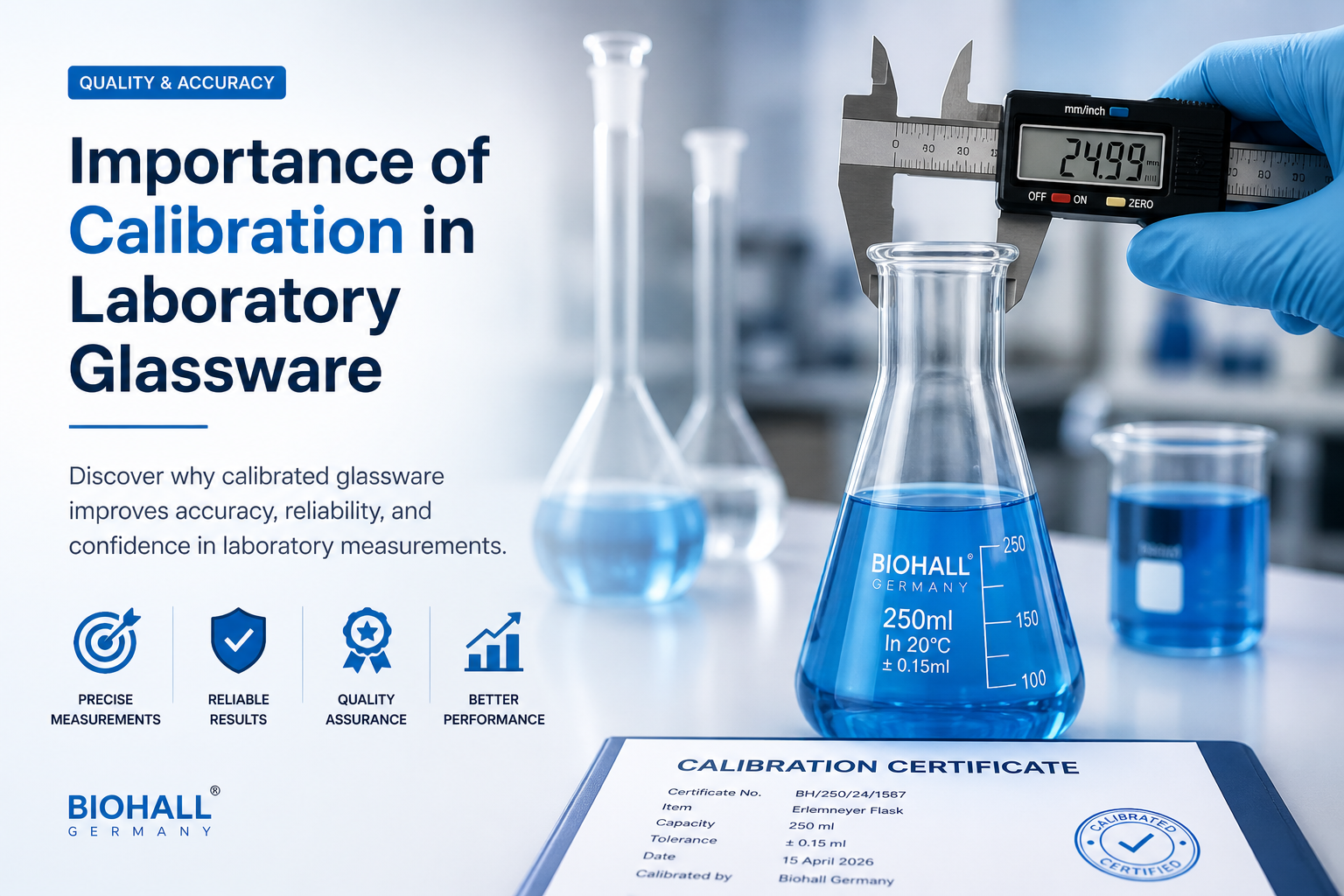
Importance of Calibration in Laboratory Glassware

Why calibrated glassware improves accuracy, reliability, and confidence in laboratory measurements

INTRODUCTION

Calibration in laboratory glassware is essential for ensuring accurate and reliable measurement results in modern laboratories.

Calibration is a critical factor in ensuring accuracy in laboratory operations. Using properly calibrated laboratory glassware helps laboratories maintain precision, consistency, and compliance in every measurement.

For distributors and procurement teams, working with reliable suppliers ensures that each product meets strict calibration standards required for modern laboratory environments. Using calibrated glassware improves laboratory accuracy and ensures consistent experimental results.


WHAT IS CALIBRATION IN LABORATORY GLASSWARE?

Calibration is the process of verifying that laboratory glassware measures volume accurately according to defined standards.

This includes instruments such as volumetric flasks, burettes, pipettes, and graduated cylinders. Proper calibration ensures that the measurements taken during experiments are accurate and repeatable.


WHY CALIBRATION IS IMPORTANT

Calibration plays a vital role in laboratory performance. It ensures accurate measurements, consistent results, reduced experimental errors, and compliance with global standards. Using calibrated glassware improves laboratory accuracy and ensures consistent experimental results.

Without proper calibration, even high-quality glassware can produce unreliable data, which can affect research outcomes and product quality.


CLASS A VS CLASS B GLASSWARE

Laboratory glassware is generally classified into Class A and Class B categories.

Class A glassware is designed for high precision and is used in critical applications where accuracy is essential. Class B glassware is suitable for general laboratory use where minor variations are acceptable.

Understanding this difference helps in selecting the right glassware based on application needs.


CALIBRATION STANDARDS & COMPLIANCE

Reliable laboratory glassware must comply with international standards such as ISO, DIN, and ASTM.

These certifications ensure that the glassware has been tested for accuracy and meets global quality requirements. Compliance also improves trust and acceptance in international markets.


MATERIAL MATTERS: BOROSILICATE GLASS

The accuracy of calibration also depends on the quality of the material used. Reliable lab glassware manufacturers focus on strict calibration processes to maintain global quality standards.

Borosilicate glass is widely preferred because of its low thermal expansion, high chemical resistance, and long-term stability. These properties ensure that the glassware maintains its accuracy even under varying laboratory conditions.


QUICK CALIBRATION CHECKLIST

When selecting laboratory glassware, always check the calibration class (Class A or B), certification standards, clarity of markings, and material quality.

Also ensure that the supplier provides consistent manufacturing and reliable documentation for calibration. Reliable lab glassware manufacturers focus on strict calibration processes to maintain global quality standards.


FINAL THOUGHTS

Calibration is not optional—it is essential for achieving reliable and repeatable results in laboratory environments.

Choosing properly calibrated glassware helps improve measurement accuracy, reduces errors, and builds confidence in laboratory outcomes.

Choosing products with proper calibration in laboratory glassware ensures long-term reliability and measurement confidence. Using calibrated glassware improves laboratory accuracy and ensures consistent experimental results.


FAQ SECTION

What is calibration in laboratory glassware?
Calibration is the process of ensuring that glassware measures volume accurately according to defined standards.

Why is calibration important?
Calibration improves accuracy, reduces errors, and ensures reliable experimental results.

What is Class A glassware?
Class A glassware is high-precision calibrated glassware used in critical laboratory applications.

How often should glassware be calibrated?
Calibration frequency depends on usage, but regular checks are recommended for maintaining accuracy.

Calibration in laboratory glassware ensures accurate results and reliable measurements in laboratory applications.

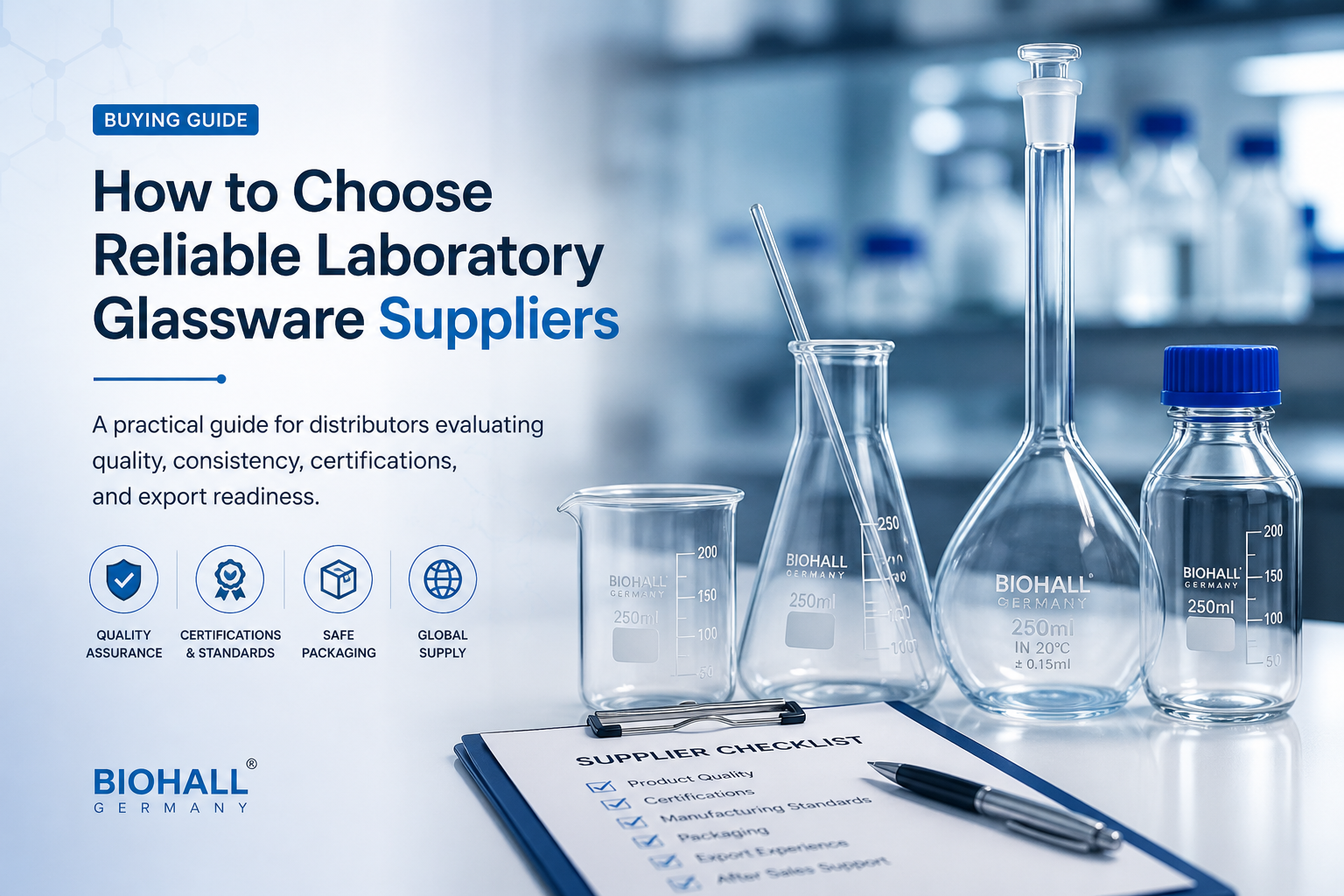
How to Choose Reliable Laboratory Glassware Suppliers

How to Choose Reliable Laboratory Glassware Suppliers

A practical guide for distributors and procurement teams looking for quality, consistency, and export-ready supply.


Introduction

In the laboratory industry, precision is everything—and that precision begins with the quality of your glassware supplier. For distributors, procurement teams, and institutional buyers, choosing the right supplier is not just about pricing—it’s about consistency, compliance, and long-term reliability.

This guide will help you identify what truly matters when selecting a laboratory glassware supplier for global or domestic supply, borosilicate glassware suppliers.


1. Check Material Quality in Laboratory Glassware Suppliers: Why Borosilicate Matters is Non-Negotiable

Reliable laboratory glassware should be manufactured using high-grade borosilicate glass (3.3).

Why it matters:

  • High resistance to thermal shock
  • Excellent chemical durability
  • Long product lifespan

Suppliers who clearly specify material standards demonstrate transparency and technical reliability.

Explore our laboratory beakers manufactured using high-grade borosilicate glass for superior performance.


2. Certifications Every Reliable Laboratory Glassware Supplier Must Have

Always verify whether the supplier meets international quality standards.

Look for:

  • ISO 9001:2015 (Quality Management)
  • ISO 17025:2017 (Calibration & Testing)
  • CE Marking
  • DIN / ISO / ASTM compliance

These certifications ensure that the products are tested, calibrated, and globally accepted.

For a deeper understanding of global laboratory standards, refer to the official ISO standards database.

Learn more about laboratory testing standards from ASTM International.


3. Accuracy & Calibration Capabilities

For volumetric glassware, precision is critical.

A reliable supplier should offer:

  • Class A and Class B glassware
  • Clearly marked graduation accuracy
  • Calibration compliance with international norms

Inconsistent calibration can directly impact lab results and credibility.

You can review our precision range of volumetric flasks designed for Class A and Class B applications.


4. Manufacturing Consistency & Batch Reliability

Consistency across batches is essential for distributors and bulk buyers.

Evaluate:

  • Uniform wall thickness
  • Consistent dimensions
  • Reliable packaging standards

Suppliers with controlled manufacturing processes ensure repeatable quality across large orders.


5. Export Readiness & Global Supply Capability

If you’re sourcing for international markets, your supplier must be export-ready.

Check for:

  • Strong export packaging (breakage-resistant)
  • Experience in global shipments
  • Compliance with international documentation

A globally experienced supplier reduces risks in logistics and customs clearance.


6. Product Range & Scalability

A strong supplier should offer a comprehensive product portfolio, including:

  • Beakers
  • Flasks (Volumetric, Round Bottom, Flat Bottom)
  • Burettes
  • Cylinders
  • Condensers
  • Bottles
  • Adapters and filtration assemblies

This allows you to scale your business with a single trusted source.

Browse our complete portfolio including laboratory bottles, burettes, and glass adapters.


7. Customization & OEM Capability

For distributors building their own brand, OEM support is a key advantage.

Look for suppliers who offer:

  • Private labeling
  • Custom branding
  • Flexible packaging solutions

This helps you create a distinct identity in your market.


8. Pricing vs Value: Don’t Chase Cheap

Low-cost glassware often compromises:

  • Accuracy
  • Durability
  • Safety

Instead, focus on:

  • Long-term value
  • Reduced breakage
  • Consistent quality

Reliable suppliers help you avoid hidden costs and customer complaints.


9. Communication & Professional Support

A dependable supplier is also strong in communication and responsiveness.

Indicators:

  • Quick response time
  • Clear documentation
  • Professional quotation process

This becomes crucial for ongoing partnerships and repeat business.


10. Reputation & Market Presence

Finally, evaluate:

  • Global distribution network
  • Industry experience
  • Client base

Suppliers with a strong presence indicate trust and long-term stability.

Quick Supplier Evaluation Checklist

Criteria What to Check
Material Borosilicate Glass 3.3
Certification ISO, CE, DIN Standards
Accuracy Class A / Class B Calibration
Export Readiness Secure Packaging & Documentation
OEM Support Private Label Options

Final Thoughts on Choosing the Right Laboratory Glassware Supplier


Conclusion

Choosing the right laboratory glassware supplier is a strategic decision. It directly affects your product quality, brand reputation, and operational efficiency.

By focusing on quality, certification, consistency, and export readiness, distributors and procurement teams can build long-term partnerships that support growth and reliability.

At Biohall Germany, we work closely with global distributors to deliver consistent, export-ready laboratory glassware solutions. Working with reliable laboratory glassware suppliers ensures consistent quality and long-term supply stability.

To ensure consistent supply and certified quality, request a quote from our team today.


Why Choose Biohall Germany

At Biohall Germany, we combine precision manufacturing with global supply expertise. Working with reliable laboratory glassware suppliers ensures consistent quality and long-term supply stability.

  • Borosilicate 3.3 glass
  • ISO-certified processes
  • Class A & Class B accuracy
  • Export-ready packaging
  • OEM & private label support

👉 Explore our range or request a quote today:
https://biohalllabware.com/bh/contact-us/

Explore our full range of graduated cylinders for precise laboratory measurements.

Frequently Asked Questions

What makes a laboratory glassware supplier reliable?

A reliable supplier offers certified products, consistent manufacturing quality, and export-ready packaging along with strong technical support.

Why is borosilicate glass preferred in laboratories?

Borosilicate glass provides high thermal resistance, chemical durability, and long-lasting performance, making it ideal for laboratory use.

What certifications should lab glassware suppliers have?

Look for ISO certifications, CE marking, and compliance with DIN or ASTM standards to ensure quality and global acceptance.

Learn more about our manufacturing expertise on the Biohall Germany homepage.

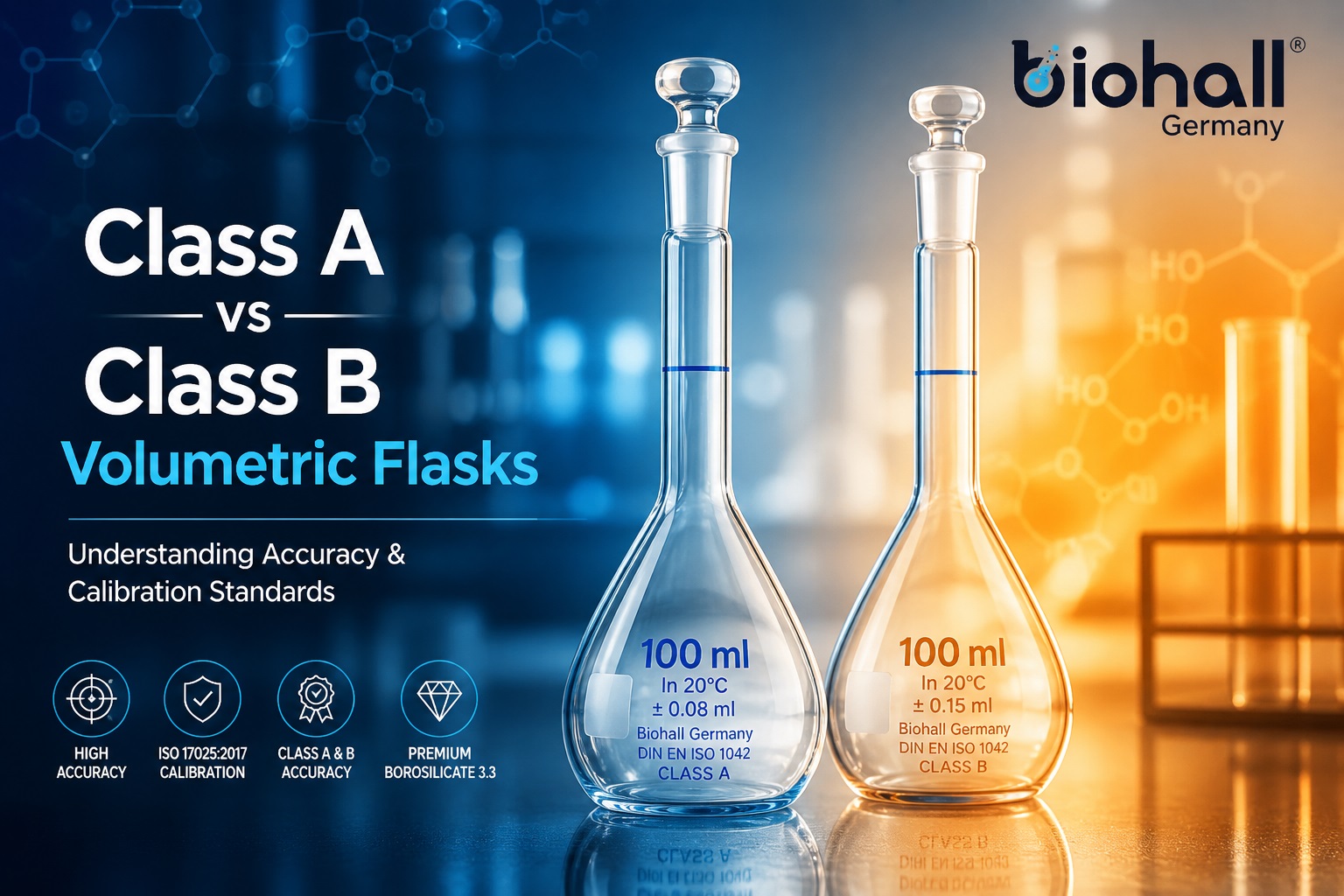
Class A vs Class B Volumetric Flasks: What’s the Difference?

Introduction

Volumetric flasks are among the most important precision instruments used in laboratories for preparing standard solutions and accurate dilutions. When selecting laboratory glassware, one common question is whether to choose a Class A volumetric flask or a Class B volumetric flask.

Understanding the difference helps laboratories maintain measurement accuracy, compliance, and efficiency.

Class A vs Class B volumetric flasks are important choices for laboratories requiring accurate liquid measurement.


What is a Volumetric Flask?

A volumetric flask is specially designed to hold an exact volume of liquid at a specified temperature. It is commonly used in:

  • Chemical laboratories
  • Pharmaceutical testing
  • Research institutions
  • Educational labs
  • Industrial quality control

Explore our premium volumetric flasks collection.

(Internal link to Flasks category)


What Are Class A vs Class B Volumetric Flasks?

What is a Class A Volumetric Flask?

A Class A volumetric flask offers higher accuracy and tighter tolerance limits. These flasks are individually calibrated and ideal for analytical work.

Class A volumetric flasks are manufactured according to strict accuracy tolerances based on ISO standards.

Best For:

  • High precision chemical analysis
  • Standard solution preparation
  • Pharmaceutical laboratories
  • Research applications

Benefits:

  • Maximum accuracy
  • Certified calibration
  • Reliable repeatability

What is a Class B Volumetric Flask?

A Class B volumetric flask has wider tolerance limits compared to Class A. It is suitable for general laboratory use where ultra-high precision is not required.

Best For:

  • Routine laboratory tasks
  • Educational institutes
  • General solution preparation
  • Cost-effective operations

Benefits:

  • Economical
  • Durable
  • Suitable for daily use

Accuracy Difference Between Class A and Class B

Class A vs Class B Volumetric Flasks

Feature Class A Class B
Accuracy Higher Standard
Tolerance Lower Higher
Calibration Precise General
Cost Premium Economical
Best Use Analytical Labs Routine Labs

Which Volumetric Flask Should You Choose?

Choose Class A volumetric flasks when measurement precision directly impacts results.

Choose Class B volumetric flasks for everyday laboratory work where standard tolerance is acceptable.


Why Choose Biohall Lifesciences

Biohall Lifesciences manufactures export-quality Class A and Class B volumetric flasks using premium borosilicate glass with strict quality standards.

We supply laboratories worldwide with:

  • High clarity borosilicate glass
  • Accurate graduation marks
  • Durable construction
  • Export packaging
  • OEM solutions

Conclusion

Both Class A and Class B volumetric flasks serve important laboratory purposes. The right choice depends on your required level of precision, budget, and application.

For dependable laboratory glassware, choose Biohall Lifesciences.


Request a Quote

Need premium volumetric flasks for your laboratory or distribution business? Contact Biohall Lifesciences today.

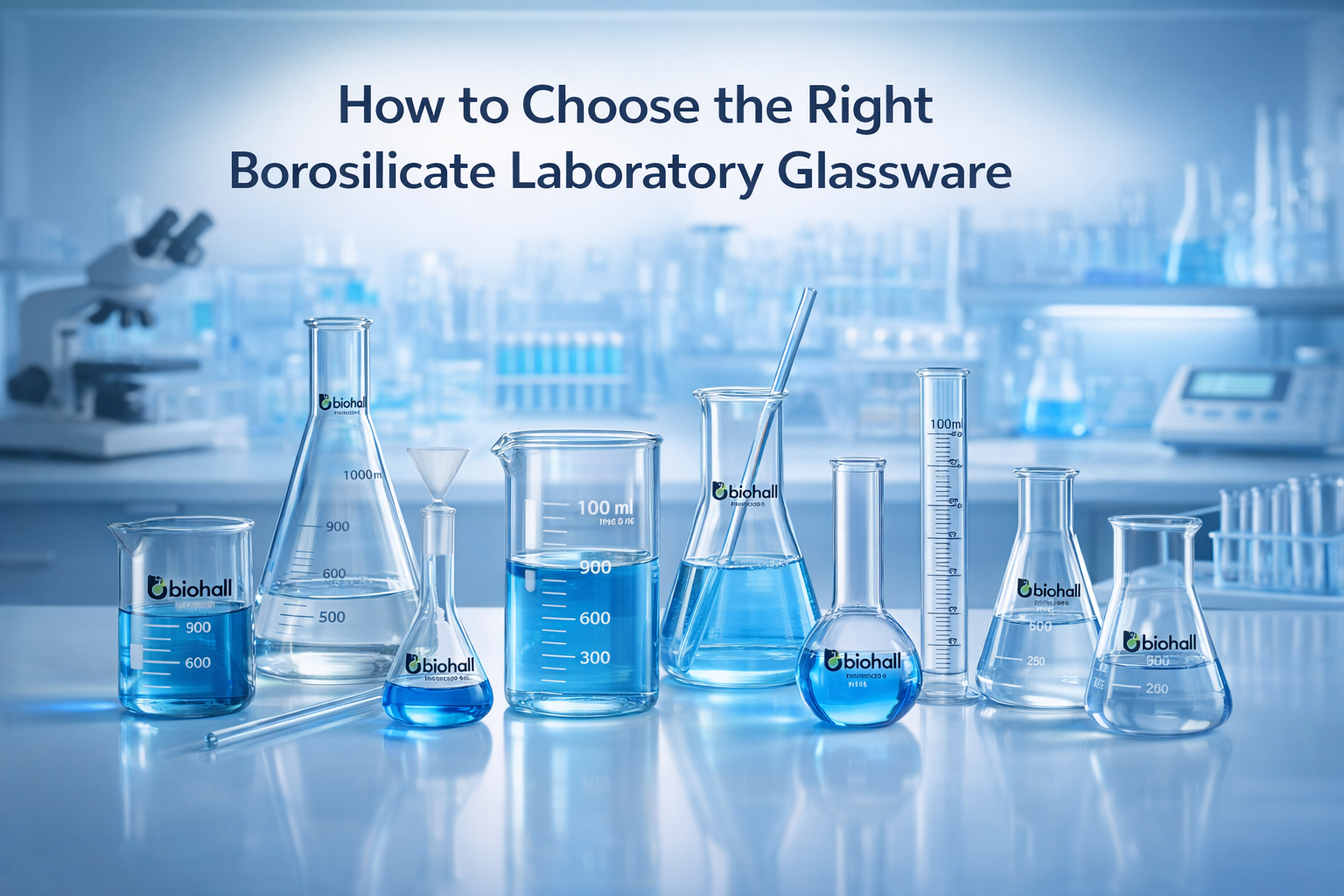
How to Choose the Right Borosilicate Laboratory Glassware

Introduction

Selecting the right laboratory glassware is essential for accuracy, safety, and long-term performance in any laboratory. Whether you work in research, pharmaceuticals, education, or industrial testing, high-quality borosilicate laboratory glassware ensures dependable results.

At Biohall Lifesciences, we manufacture and export premium laboratory glassware designed to meet international quality standards.


Why Borosilicate Laboratory Glassware is Preferred

Borosilicate glass is the most trusted material for laboratory use because it offers:

  • High thermal resistance
  • Excellent chemical durability
  • Low expansion under heat
  • Crystal clear visibility
  • Long service life

This makes it ideal for heating, mixing, measuring, and storing chemicals.


1. Choose Based on Application

Different experiments require different glassware.

For Measuring Liquids

Use:

These products are designed for precision volume measurement.

For Heating & Mixing

Use:

  • Beakers
  • Conical Flasks
  • Flat Bottom Flasks
  • Round Bottom Flasks

These are suitable for heating plates and chemical mixing.

For Storage

Use:

  • Reagent Bottles
  • Media Bottles
  • Sample Containers

2. Check Accuracy Grade

For laboratories requiring exact measurement, choose:

  • Class A Glassware – High precision calibration
  • Class B Glassware – General laboratory use

Biohall offers both Class A and Class B options depending on your requirements.


3. Verify Heat & Chemical Resistance

Always ensure the glassware can withstand:

  • Direct heating
  • Acidic solutions
  • Alkalis
  • Frequent sterilization

Borosilicate glass performs exceptionally under demanding laboratory conditions.


4. Look for Quality Standards

Trusted manufacturers follow recognized standards such as:

  • ISO 9001:2015
  • ISO 17025:2017
  • CE Marking
  • DIN / ASTM specifications

Biohall Lifesciences manufactures laboratory glassware with strict quality control for global markets.


5. Select the Right Size & Joint Type

Glassware is available in multiple capacities and joint sizes.

Examples:

Always match product size to your process volume.


Why Choose Biohall Lifesciences Laboratory Glassware

We are trusted by laboratories across 45+ countries for:

  • Premium borosilicate laboratory glassware
  • Accurate calibration
  • OEM / Custom manufacturing
  • Export quality packaging
  • Wide product range

Precision in Every Drop | Global Laboratory Glassware Experts


Conclusion

Choosing the right borosilicate laboratory glassware improves safety, efficiency, and test accuracy. Always select products based on application, precision grade, durability, and quality certifications.

For dependable laboratory glassware solutions, choose Biohall Lifesciences.


Request a Quote

Need premium beakers, flasks, burettes, or custom laboratory glassware?

Contact Biohall Lifesciences today for global supply and OEM solutions.

https://biohalllabware.com/bh/contact/

Proudly powered by Themelexus.com
CLOSE

Biohall Lifesciences

Trusted manufacturer and exporter of precision laboratory glassware for laboratories, distributors, institutions and industrial buyers worldwide.

45+ Countries OEM Support Borosilicate 3.3 Export Ready

Quick Links

Home About Us Products Categories Contact

Product Categories

Adapters Beakers Bottles Burettes Cylinders Flasks Columns All Products

Contact

Email: info@biohalllabware.com
Phone: +91 9971207825
Phone: +91 8920609363
Ambala Cantt, Haryana, India

WhatsApp Email
© 2026 Biohall Lifesciences. All Rights Reserved.
Precision in Every Drop | Global Laboratory Glassware Experts
X
Add to cart