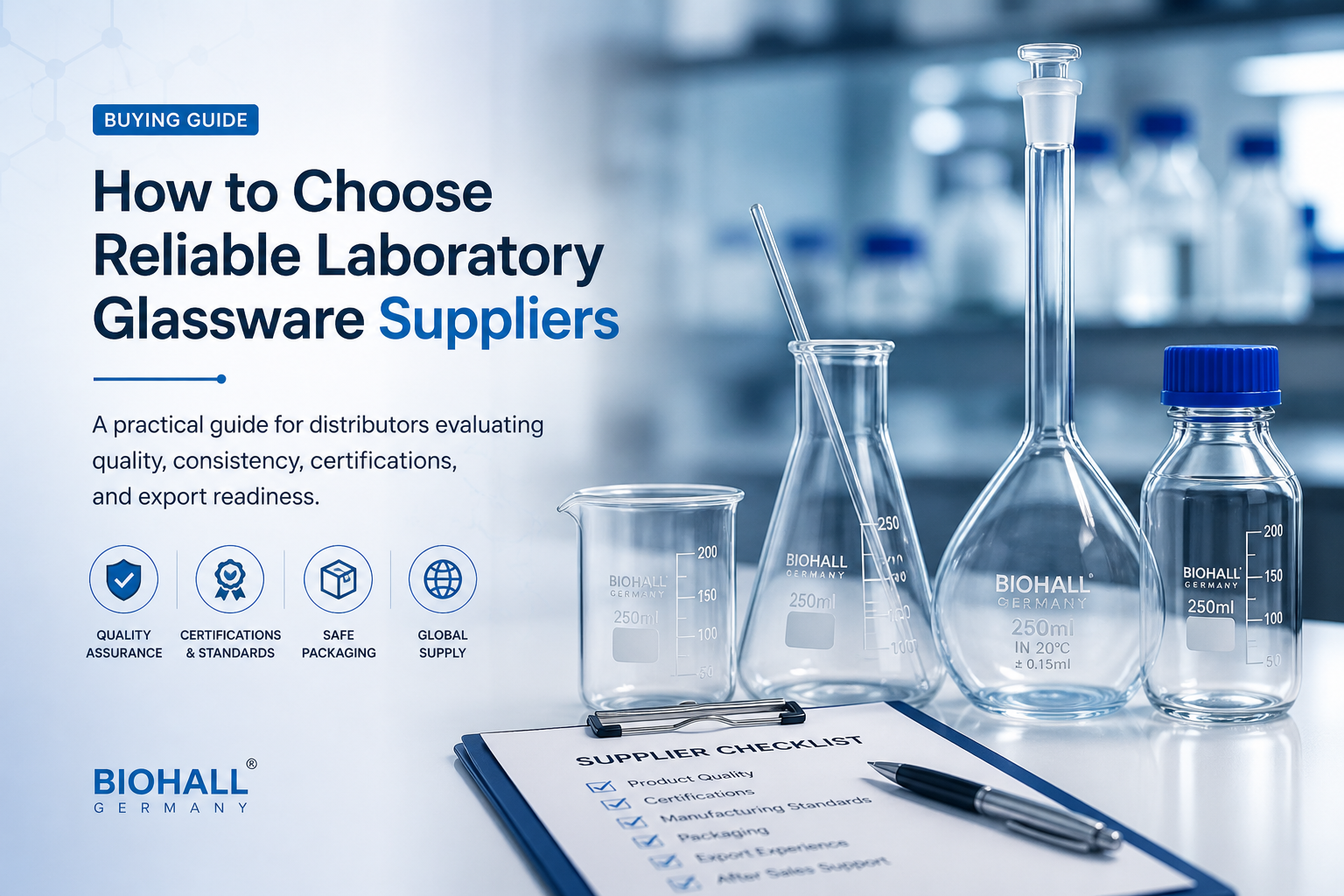
How to Choose Reliable Laboratory Glassware Suppliers
A practical guide for distributors and procurement teams looking for quality, consistency, and export-ready supply.
Introduction
In the laboratory industry, precision is everything—and that precision begins with the quality of your glassware supplier. For distributors, procurement teams, and institutional buyers, choosing the right supplier is not just about pricing—it’s about consistency, compliance, and long-term reliability.
This guide will help you identify what truly matters when selecting a laboratory glassware supplier for global or domestic supply, borosilicate glassware suppliers.
1. Check Material Quality in Laboratory Glassware Suppliers: Why Borosilicate Matters is Non-Negotiable
Reliable laboratory glassware should be manufactured using high-grade borosilicate glass (3.3).
Why it matters:
- High resistance to thermal shock
- Excellent chemical durability
- Long product lifespan
Suppliers who clearly specify material standards demonstrate transparency and technical reliability.
Explore our laboratory beakers manufactured using high-grade borosilicate glass for superior performance.
2. Certifications Every Reliable Laboratory Glassware Supplier Must Have
Always verify whether the supplier meets international quality standards.
Look for:
- ISO 9001:2015 (Quality Management)
- ISO 17025:2017 (Calibration & Testing)
- CE Marking
- DIN / ISO / ASTM compliance
These certifications ensure that the products are tested, calibrated, and globally accepted.
For a deeper understanding of global laboratory standards, refer to the official ISO standards database.
Learn more about laboratory testing standards from ASTM International.
3. Accuracy & Calibration Capabilities
For volumetric glassware, precision is critical.
A reliable supplier should offer:
- Class A and Class B glassware
- Clearly marked graduation accuracy
- Calibration compliance with international norms
Inconsistent calibration can directly impact lab results and credibility.
You can review our precision range of volumetric flasks designed for Class A and Class B applications.
4. Manufacturing Consistency & Batch Reliability
Consistency across batches is essential for distributors and bulk buyers.
Evaluate:
- Uniform wall thickness
- Consistent dimensions
- Reliable packaging standards
Suppliers with controlled manufacturing processes ensure repeatable quality across large orders.
5. Export Readiness & Global Supply Capability
If you’re sourcing for international markets, your supplier must be export-ready.
Check for:
- Strong export packaging (breakage-resistant)
- Experience in global shipments
- Compliance with international documentation
A globally experienced supplier reduces risks in logistics and customs clearance.
6. Product Range & Scalability
A strong supplier should offer a comprehensive product portfolio, including:
- Beakers
- Flasks (Volumetric, Round Bottom, Flat Bottom)
- Burettes
- Cylinders
- Condensers
- Bottles
- Adapters and filtration assemblies
This allows you to scale your business with a single trusted source.
Browse our complete portfolio including laboratory bottles, burettes, and glass adapters.
7. Customization & OEM Capability
For distributors building their own brand, OEM support is a key advantage.
Look for suppliers who offer:
- Private labeling
- Custom branding
- Flexible packaging solutions
This helps you create a distinct identity in your market.
8. Pricing vs Value: Don’t Chase Cheap
Low-cost glassware often compromises:
- Accuracy
- Durability
- Safety
Instead, focus on:
- Long-term value
- Reduced breakage
- Consistent quality
Reliable suppliers help you avoid hidden costs and customer complaints.
9. Communication & Professional Support
A dependable supplier is also strong in communication and responsiveness.
Indicators:
- Quick response time
- Clear documentation
- Professional quotation process
This becomes crucial for ongoing partnerships and repeat business.
10. Reputation & Market Presence
Finally, evaluate:
- Global distribution network
- Industry experience
- Client base
Suppliers with a strong presence indicate trust and long-term stability.
Quick Supplier Evaluation Checklist
| Criteria | What to Check |
|---|---|
| Material | Borosilicate Glass 3.3 |
| Certification | ISO, CE, DIN Standards |
| Accuracy | Class A / Class B Calibration |
| Export Readiness | Secure Packaging & Documentation |
| OEM Support | Private Label Options |
Final Thoughts on Choosing the Right Laboratory Glassware Supplier
Conclusion
Choosing the right laboratory glassware supplier is a strategic decision. It directly affects your product quality, brand reputation, and operational efficiency.
By focusing on quality, certification, consistency, and export readiness, distributors and procurement teams can build long-term partnerships that support growth and reliability.
At Biohall Germany, we work closely with global distributors to deliver consistent, export-ready laboratory glassware solutions. Working with reliable laboratory glassware suppliers ensures consistent quality and long-term supply stability.
To ensure consistent supply and certified quality, request a quote from our team today.
Why Choose Biohall Germany
At Biohall Germany, we combine precision manufacturing with global supply expertise. Working with reliable laboratory glassware suppliers ensures consistent quality and long-term supply stability.
- Borosilicate 3.3 glass
- ISO-certified processes
- Class A & Class B accuracy
- Export-ready packaging
- OEM & private label support
👉 Explore our range or request a quote today:
https://biohalllabware.com/bh/contact-us/
Explore our full range of graduated cylinders for precise laboratory measurements.
Frequently Asked Questions
What makes a laboratory glassware supplier reliable?
A reliable supplier offers certified products, consistent manufacturing quality, and export-ready packaging along with strong technical support.
Why is borosilicate glass preferred in laboratories?
Borosilicate glass provides high thermal resistance, chemical durability, and long-lasting performance, making it ideal for laboratory use.
What certifications should lab glassware suppliers have?
Look for ISO certifications, CE marking, and compliance with DIN or ASTM standards to ensure quality and global acceptance.
Learn more about our manufacturing expertise on the Biohall Germany homepage.