Difference Between Borosilicate Glass and Ordinary Glass
Difference Between Borosilicate Glass and Ordinary Glass
Glass is widely used across scientific, industrial, and household applications, but not all glass offers the same level of performance. In laboratory environments, selecting the right glass material is essential for safety, durability, thermal resistance, and scientific accuracy.
One of the most important comparisons in scientific glassware is the difference between borosilicate glass and ordinary glass. While ordinary glass may work for general applications, modern laboratories prefer borosilicate laboratory glassware because of its superior heat resistance, chemical durability, and long-term reliability.
At Biohall Lifesciences, we manufacture premium-quality borosilicate laboratory glassware designed for demanding scientific and industrial laboratory applications.
What Is Ordinary Glass?
Ordinary glass, also known as soda-lime glass, is the most commonly used glass material in everyday products such as bottles, windows, containers, and household items.
It is manufactured primarily using:
- Silica
- Sodium carbonate
- Calcium oxide
Although ordinary glass is cost-effective for general use, it is not designed to withstand sudden temperature changes or aggressive laboratory chemicals.
What Is Borosilicate Glass?
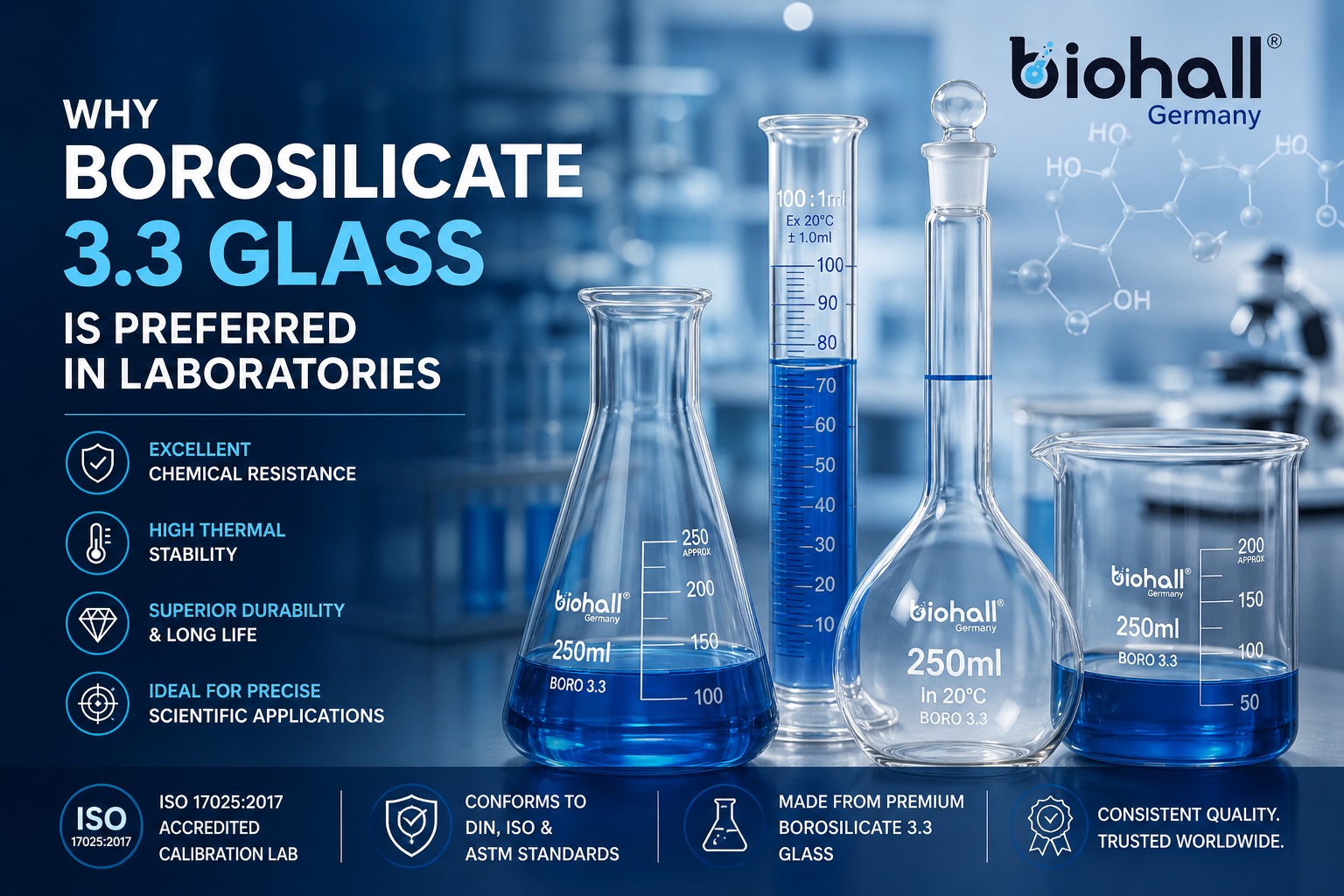
Borosilicate glass is a specialized type of glass engineered for scientific and industrial applications requiring thermal stability and chemical resistance.
Unlike ordinary glass, borosilicate glass contains boron trioxide, which significantly improves its durability and resistance to thermal shock.
This makes borosilicate laboratory glassware ideal for:
- Heating applications
- Chemical handling
- Scientific experiments
- Industrial testing
- Pharmaceutical laboratory procedures
Key Difference Between Borosilicate Glass and Ordinary Glass
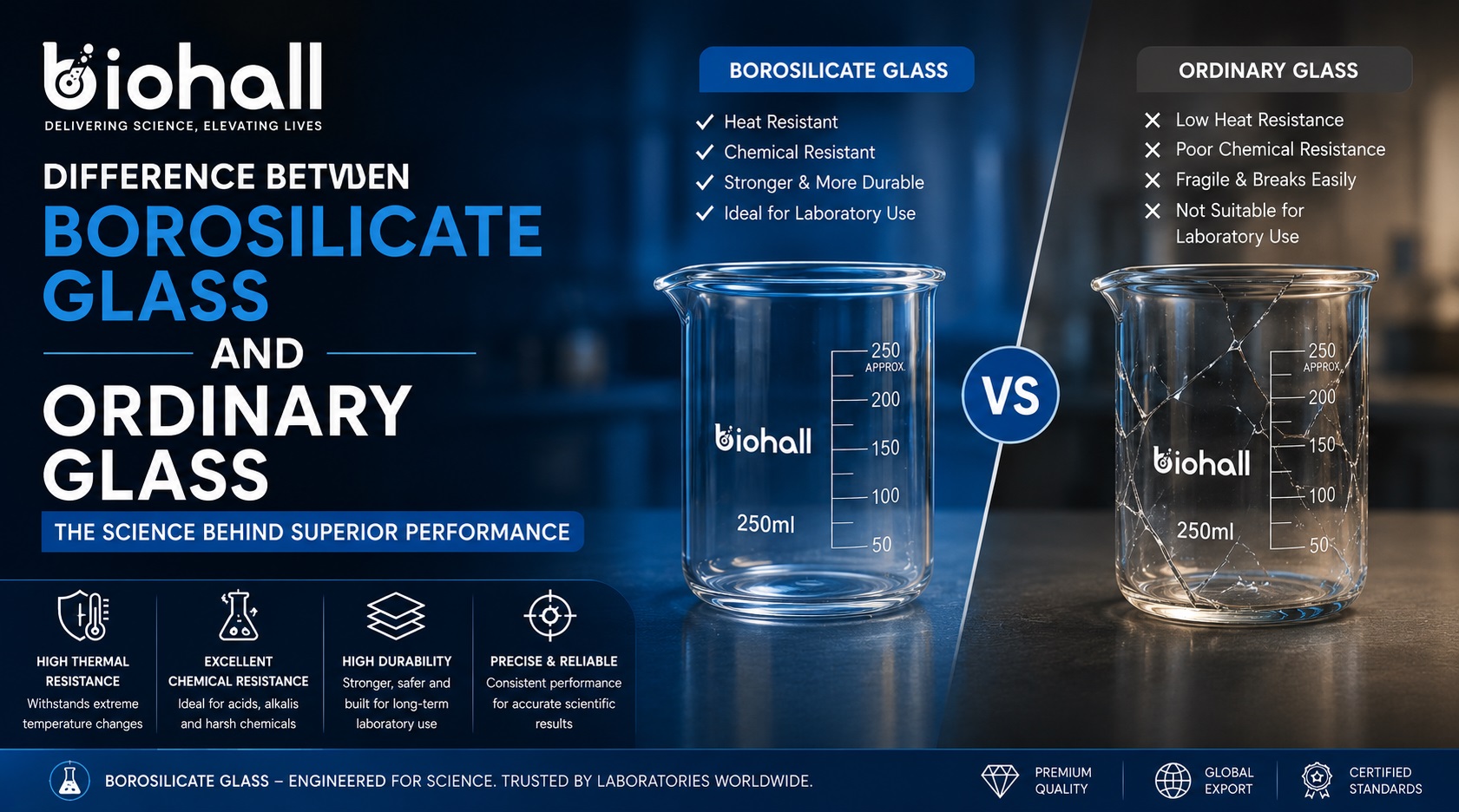
1. Thermal Resistance
The biggest difference between borosilicate glass and ordinary glass is heat resistance.
Ordinary Glass
Ordinary glass expands quickly under heat and may crack when exposed to sudden temperature changes.
Borosilicate Glass
Borosilicate glass has a very low thermal expansion rate, allowing it to withstand:
- Direct heating
- Hot plate usage
- Thermal shock
- Rapid temperature fluctuations
This is why laboratories prefer heat resistant laboratory glassware manufactured from borosilicate glass.
2. Chemical Resistance
Scientific laboratories regularly handle acids, solvents, and reactive chemicals.
Ordinary Glass
Ordinary glass may degrade or weaken under chemical exposure over time.
Borosilicate Glass
Borosilicate glass provides excellent chemical resistance against:
- Acids
- Alkalis
- Solvents
- Corrosive substances
This makes it a preferred material for chemical resistant glassware used in laboratories worldwide.
3. Durability and Strength
Borosilicate glass is significantly more durable than ordinary glass in scientific environments.
Advantages Include:
- Reduced cracking risk
- Better temperature tolerance
- Longer service life
- Improved laboratory safety
Because laboratory procedures often involve repeated heating and handling, durable scientific glassware is essential for operational reliability.
4. Laboratory Applications
Ordinary glass is typically unsuitable for scientific heating applications, while laboratory borosilicate glass is widely used in research and industrial laboratories.
Common Borosilicate Laboratory Products:
- Laboratory beakers
- Volumetric flasks
- Burettes
- Cylinders
- Condensers
- Reagent bottles
- Distillation apparatus
These products are manufactured for precision scientific operations requiring dependable performance.
5. Transparency and Clarity
Both ordinary glass and borosilicate glass offer good transparency, but borosilicate laboratory glassware maintains clarity even after repeated laboratory usage and exposure to heat and chemicals.
This improves:
- Observation accuracy
- Liquid visibility
- Measurement readability
- Scientific monitoring
Why Laboratories Prefer Borosilicate Glassware
Modern laboratories prioritize:
- Safety
- Precision
- Thermal resistance
- Chemical durability
- Long-term reliability
Because of these requirements, borosilicate glass uses in laboratory applications continue to grow worldwide.
Research laboratories, pharmaceutical facilities, educational institutions, and industrial laboratories depend on borosilicate laboratory glassware for accurate and safe scientific procedures.
Advantages of Borosilicate Laboratory Glassware
Key Benefits:
- High thermal stability
- Excellent chemical resistance
- Long service life
- Reduced contamination risk
- Suitable for direct heating
- Superior scientific reliability
These characteristics make borosilicate glass one of the most important materials used in laboratory manufacturing today.
Conclusion
Understanding the difference between borosilicate glass and ordinary glass is important for laboratories seeking dependable scientific performance and safety.
While ordinary glass is suitable for everyday applications, borosilicate laboratory glassware offers superior durability, heat resistance, and chemical stability required for scientific and industrial environments.
Biohall Lifesciences manufactures export-quality borosilicate laboratory glassware designed for laboratories, distributors, and scientific institutions worldwide.
Borosilicate Glass vs Ordinary Glass FAQ
Learn the key differences between borosilicate glass and ordinary glass used in laboratory and scientific applications.